The body often knows what the mind is not yet ready to face.
“Life became my practice,
and mistakes became my teacher.”
About liza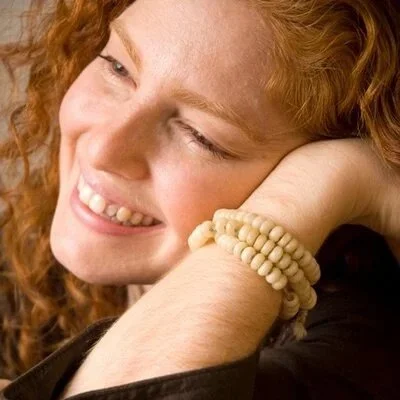
I learned this first in my own life. For years, fear, anxiety, and trauma lived quietly in my body until they began to speak through migraines, anemia, and relational patterns I could no longer explain away.
What began as a search for relief became a deeper inquiry. It led me through holistic treatment, training in core anatomy and movement, graduate study in Classical Chinese Medicine, years of meditation practice, and eventually three months of solitary retreat in a cabin in Vermont.
Along the way, I came to understand that there is no final arrival point called “healed.” There is only growing capacity: to listen more carefully, be more honest with myself, and allow change to take root.
My earliest training was in listening.
I began playing violin when I was three, later worked in music production, and eventually created and ran a jazz venue. Again and again, my work trained me to hear what was present, what was missing, what needed support, and what wanted to come forward.
That kind of attention now shapes the way I work with people. I listen for the words, but also for what lives between them: the hesitation, the contradiction, the body’s response, and the truth before it has language.
I work best with people who are ready to participate in their own healing.
I bring attention, intuition, clinical training, and care, but the work becomes powerful when you are willing to meet what is being revealed with honesty, courage, and action.
The teachers who shaped this work.
a deep bowMy primary clinical lineage is in Classical Chinese Medicine, which I studied for three years with Jeffrey Yuen, an 88th-generation Taoist priest and heir to an ancient oral tradition. His teaching opened me to a way of understanding the body that is precise, expansive, and deeply human.
My understanding of the structural body was shaped by training with Kelly Kane, founder of the Kane School in New York, whose approach bridges classical movement with a rigorous, clinical knowledge of anatomy, biomechanics, and movement rehabilitation.
My approach to trauma and the ways it lives in the body was informed by the work of Gabor Maté, MD, through his Compassionate Inquiry training.
Years of meditation practice across the Tibetan Gelug, Shambhala, and Vipassana traditions have shaped how I sit with people - the quality of attention I bring, and the patience to let what is true emerge in its own time.
LICENSE & DEGREELicensed Acupuncturist
M.Sc. Chinese Medicine